
Lake Ridge Previous Residents by Era
Previous residents research has two tracks. The deed trail identifies parties to transfers and the legal description that links a parcel across time. The household trail uses dated directories, census schedules, newspapers, obituaries, probate, and similar sources. Start with the most recent reliable parcel record and choose the older source by its date range. A house can have a new street number or subdivision label while the legal description remains the bridge.
| Source | Years It Covers | Where Held | What It Shows |
|---|---|---|---|
| Modern land-record index | 1918-present baseline | Circuit Clerk PublicSearch | Transfers, parties, instruments, legal descriptions |
| Historical Online Portal | Colonial period to early 1900s, by collection | Circuit Clerk HOP | Archived deeds, wills, heirs, marriage material |
| RELIC deeds index | 1731-1827 | RELIC Digital Archives / clerk source | Surname, book, page, and remarks index |
| Local directories | 1963-1980; 2001; 2007-2020, with gaps | RELIC | Dated address and household context |
| Federal census | 1790-1950 public | NARA, RELIC, library databases | Household snapshot, not current residence |
Modern parcel, deed, and GIS records are the best entry point for a Lake Ridge house. When the time period reaches the earliest community years, use the local directory vocabulary, 1972 map, 1975-1987 diary, and county historical sources. For land before development, search the underlying tract or road. The date attached to the source controls what it can establish.
Lake Ridge Deed Research Moves Backward
Prince William's online overview gives a 1918-present baseline for deeds and related land-record images. Begin at the current parcel, find the most recent transfer, then search that seller as a prior buyer. The modern index can stop before the property's full history does. The historical route then moves through HOP, physical books, RELIC's deed index, Library of Virginia microfilm, plats, and the Circuit Clerk's research service.
The county's 1731-1827 deed index is a finding aid, not a complete deed-image collection. Its surviving volume covers M-W grantor and grantee names, while some books and sections were lost after Civil War disruption. A missing entry can reflect a gap, a spelling issue, an unindexed book, or a different locality. Preserve the book, page, surname range, and index note.
The Circuit Clerk research page below connects to historical sources and the office's alternate research routes.
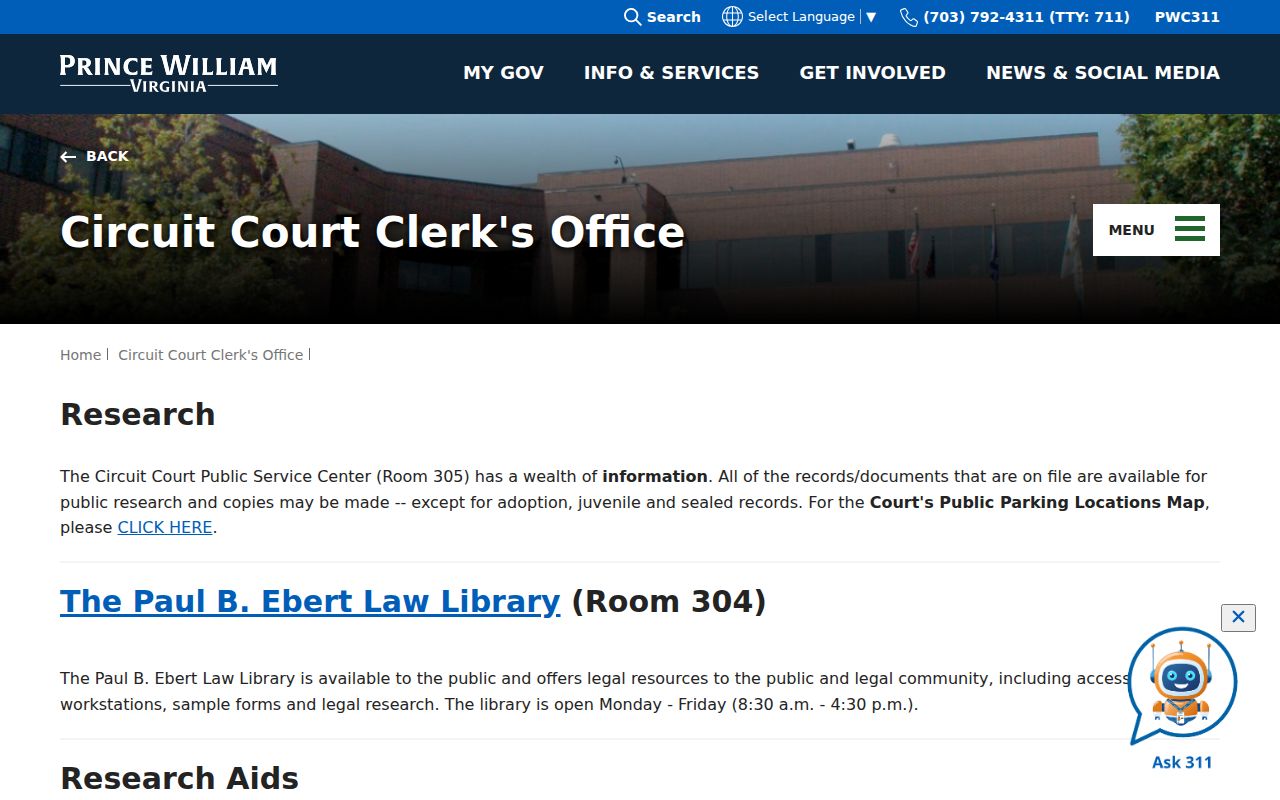
Use the clerk, historical portal, or mail and in-person research route when the needed document is not in the modern online results.
Lake Ridge Maps Bridge Earlier Addresses
No official Lake Ridge-specific Sanborn sheet or historical address-conversion table was located. The defensible alternative is a chain of deed legal description, recorded plat, GPIN history, and dated maps. County GIS has 1937 and later aerial imagery. RELIC has 1962 and 1972 maps. Historic Prince William holds a 1972 county street map. Use the image year with a deed or plat date rather than asserting that a current street name appeared in an older record.
Lake Ridge development began in 1969. A pre-development record may use Prince William County, Woodbridge, Occoquan, Dumfries, a rural road, or a tract. The county Parcel History Tree can help relate parent and child GPINs after a subdivision or boundary change. It is a stronger bridge than guessing from a current street label.
The Circuit Clerk special-projects source below describes historical material, including 1937 aerial imagery and highway-plat research.
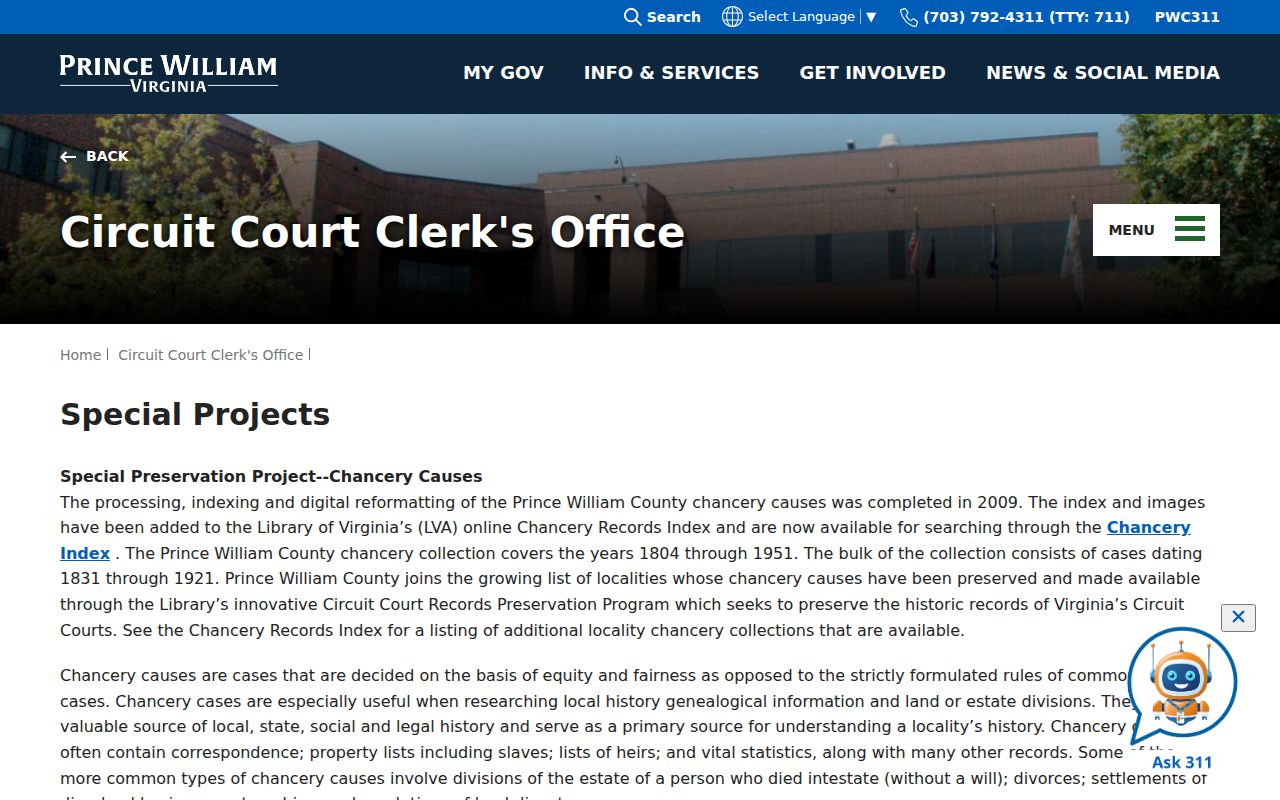
Historical maps and special collections can explain a parcel's landscape, but a recorded plat or deed remains the key legal record.
Trace Lake Ridge Deed Chains Backward
A chain of title follows transfers of an interest in land. It starts with the current parcel record and the latest recorded deed, not with a remembered surname. Use the exact legal description, GPIN, instrument number, and book or page to distinguish a property from another one with a similar address. A seller can be an estate, trust, corporation, or a group of people, so a transaction does not itself name a household.
- Find the address in County Mapper and PublicAccessNow, then copy its GPIN, account, legal description, subdivision fields, and map date.
- Search the Circuit Clerk land-record index for the latest transfer and retain its instrument details.
- Search the seller as a prior grantee, using the legal description and plat references to avoid a same-name error.
- Repeat one transfer at a time, recording the grantor, grantee, document type, date, book or page, and any estate or trust role.
- When the modern index ends, move to HOP, older deed books, RELIC, Library of Virginia microfilm, or the clerk copy and research route.
- Grantor / grantee
- The grantor transfers an interest; the grantee receives it in the recorded instrument.
- Chain of title
- The ordered trail of recorded transfers connected to the same land interest.
- Legal description
- The lot, block, phase, section, metes-and-bounds, or other formal property description that can outlast a street-address change.
Lake Ridge House History Has a Local Desk
RELIC at Prince William Public Libraries is the strongest local-history stop for a Lake Ridge house question. Its house-history guidance recommends beginning with public ownership records, County Mapper, Real Estate Assessments, and Manassas resources. The center holds maps, directories, newspapers, family files, county microfilm, photos, yearbooks, and local indexes. Its Local News Index covers Prince William news and obituaries from 1993, with some obituary material as early as 1970.
RELIC's public page has two inconsistent sets of displayed hours, so call before traveling. Comprehensive local city and telephone directories are not fully digitized. That makes the staff, on-site volumes, catalog, and digital archives part of the normal research route. The collection can identify a dated household or historical reference; it cannot replace a certified record or establish a present address.
RELIC's house-history guidance is shown below and links to the local research starting point.
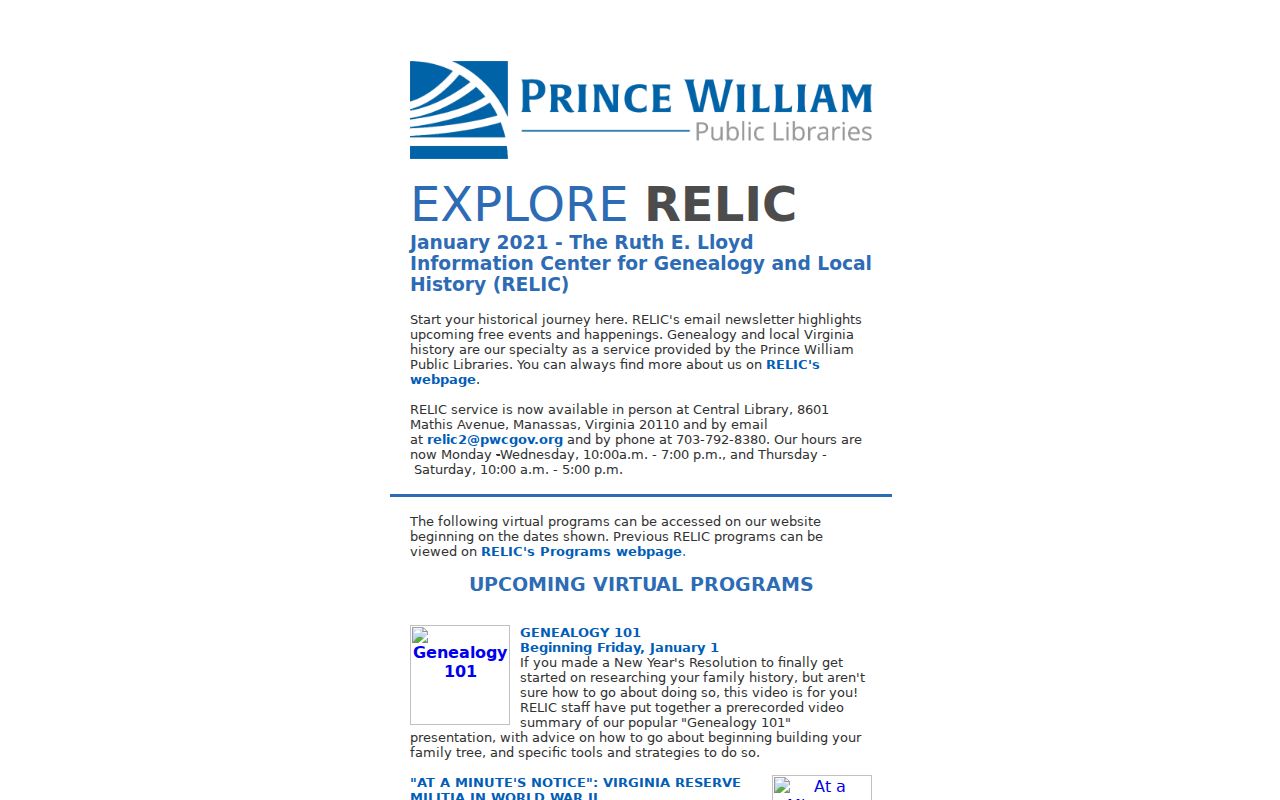
Pair the library's dated local material with the parcel and deed trail instead of treating one source as the entire history.
Lake Ridge Directories Need Census Pairing
Use a dated directory or reverse section to identify a name-address connection, then check a census schedule only when its year and locality fit. Federal census schedules from 1790 through 1950 are public; 1960 opens in 2032. A census is a household snapshot, not a parcel title record. Lake Ridge did not yet exist as a planned-community label in many older census years, so the record may use county or nearby-locality vocabulary.
- Copy the directory volume, page, year, spelling, and address exactly.
- Compare the directory date with the closest released census schedule and its locality label.
- Use the parcel's legal description, map, and deed dates to test whether the historical address belongs to the same land.
- Check RELIC newspaper, obituary, probate, and map collections for a dated event that supports the interval.
RELIC's precise directory runs are described in the Lake Ridge city directories, which owns the collection-by-collection details.
Lake Ridge Probate Can Close a Trail
A transfer from an estate or a recorded fiduciary document can point to a probate route. The Circuit Clerk holds fiduciary and probate records, with an online 1981-present baseline for fiduciary records in the county overview. Historical access varies through HOP, clerk research, RELIC, and Library of Virginia sources. A will, list of heirs, chancery file, or obituary should remain dated and source-specific.
Chancery material in the Circuit Clerk special projects can contain correspondence, property lists, heirs, and vital facts that do not appear in a basic deed index. It is a high-value research lead, but not every property or family appears in it. A person named as an heir or party should not be called the current owner without a later parcel and deed check.
Lake Ridge Past Households Need Dates
Ownership is only one part of an address history. A criss-cross directory can connect a dated address or telephone entry to a name when that volume has a reverse section. A census can supply a household snapshot for its enumeration date. Newspapers, obituaries, and probate can mark an event such as a death, move, or estate transfer. None should be presented as a timeless resident list. Keep the source date and its exact locality label beside the result.
RELIC's Local News Index, cemetery files, directory volumes, and digital archives are useful historical routes. The Library of Virginia warns of early Prince William record loss, especially around Civil War disruption, so absence in an old index is not proof that no person or transfer existed. Use the original collection or clerk record to confirm an index result when possible.
Lawful use. Lake Ridge previous-resident research is for house history, family history, estate questions, and personal curiosity. Do not use a dated record or address trail to harass, track, intimidate, or harm a living person.
Lake Ridge Previous Residents and Property Alerts
The Circuit Clerk announced free Property Alert notifications on July 10, 2025. Registration by name or GPIN can send an email when a deed, mortgage, satisfaction, or another instrument is recorded. It is useful for watching a parcel's new filings after a historical trail has been documented. The alert does not prove that a named party lives at the address, and it cannot fill a gap in earlier records.
For a copy, certification, or historical instrument question, use the clerk's current fee page and request form. The Technology Trust Fee changed from $5 to $8 on July 1, 2026, but copy and certification costs are separate and should be confirmed at the time of request. The safest result combines a source date, instrument detail, and clear statement of what that record can show.
Note: A new recorded document can start a new research interval, but it never replaces the date-bounded evidence required for an earlier household.
Lake Ridge Previous Residents Need a Parcel Start
Start an address history in the present. Validate the delivery address with USPS, locate it in County Mapper, and record the GPIN, parcel account, property address, owner or mailing address, subdivision, phase, section, block, legal description, acreage, and map date. The assessor can then show property details, sale information, assessments, and history. A parcel may have a mailing address outside Lake Ridge, and that field is not a certification of who lives there.
The County Mapper parcel layer supplies street components, ZIP, subdivision information, deed book or page, recorded date, and other geographic fields. Its Parcel History Tree can link parent and child GPINs after a split or boundary change. This is particularly important for a planned community, where a current address can hide an earlier tract description. A GPIN edit date is not the same as a recorded deed date.
Write the date of each parcel result. That simple practice keeps a current county display from being mistaken for a historical ownership interval.
Lake Ridge Previous Residents Follow HOP Gaps
When a Lake Ridge deed trail reaches past the modern index, the Circuit Clerk's Historical Online Portal is the next official historical route. HOP releases are collection-specific and can include archived deeds, wills, lists of heirs, and marriage licenses. The county's 2024 and 2025 preservation announcements describe work on court minutes, marriage registers, land documents, and deed books from colonial through mid-1800s periods. Public access does not mean every book or image is already online.
The Library of Virginia county microfilm guide adds court, deed, marriage, probate, tax, and other categories, while warning of historic losses. The 1731-1827 deed index can preserve a transaction where an underlying book is missing, but its coverage and missing sections must be reported with the result. A clerk research request, historical books, RELIC, and Library of Virginia reels are the documented alternatives when HOP does not expose the needed material.
Do not turn a gap into a presumed owner. State the inaccessible or missing source, the date range searched, and the next official route.
Lake Ridge Previous Residents Use Locality Names
Lake Ridge is a Census-designated place and a planned community. Historic sources can instead use Woodbridge, Occoquan, Dumfries, Prince William County, a road, a subdivision, or a tract. The Quantico-Triangle-Dumfries-Woodbridge-Occoquan directory run reaches 1963-1980 and is therefore a bridge to the earliest Lake Ridge years, not a full Lake Ridge city directory. Prince William County directories for 2001 and 2007-2020 are later and broader. Both require the volume date to stay attached.
The 1972 Prince William street map and the 1975-1987 Peg Williams Lake Ridge diary add community context close to the early development period. County GIS has 1937 aerial imagery and later aerial years. RELIC has maps from 1759, 1820, 1901, 1904, 1923, 1933, 1962, and 1992. Compare the map year, deed date, and address terminology rather than treating an old image as a direct resident record.
Lake Ridge's March 29, 1972 recorded declaration is a useful early-community marker. It is not a boundary for every parcel or a substitute for the actual recorded plat and deed.
Lake Ridge Previous Residents End With Events
An obituary, probate file, marriage record, newspaper story, or cemetery source can close a time window in an address trail. RELIC's Local News Index covers Prince William news and obituaries from 1993, with some obituaries as early as 1970. Its digital archive has historic vital indexes, probate material, newspapers, and collections that must be read by their own dates. A death certificate is a separate VDH product with eligibility and public-release limits, not an automatic replacement for an obituary.
Virginia vital records are public after 100 years for births and 25 years for deaths, marriages, divorces, and annulments. Current certificates have relationship, authorization, identification, and fee rules. For earlier Prince William material, RELIC and the Library of Virginia often provide the right historical path. For a probate question, the Circuit Clerk's fiduciary route and HOP can provide an estate date and document trail, subject to record-specific access.
A dated death, probate, or newspaper reference can explain why a parcel changed hands. It still does not prove the entire household lived at a property at every point in the interval.
Lake Ridge Previous Residents Require Limits
Public source access varies by record. Land instruments are generally open, while vital certificates, voter data, protected addresses, juvenile matters, sealed cases, and DMV personal data have statutory limits. Virginia's Address Confidentiality Program can provide a substitute address, and protective-order rules can withhold residential address and telephone information. A blank, redacted, or limited result may be a lawful outcome.
For a narrow county record not online, Virginia FOIA permits a request for existing records with reasonable specificity. Name the office, record series, date range, property or geography, and fields needed. The county need not create an address-history report, verify someone's current whereabouts, or combine databases. Reasonable costs and redactions can apply. Confirm a current fee or response rule with the custodian before relying on it.
Note: Previous-resident research is most accurate when it reports the source, date, legal or geographic key, and uncertainty instead of presenting a historical record as a present-day fact.